Unpacking the Read Write Inc program in community.
In a room filled with thousands of teachers, you will inevitably find robust, philosophical debate over the best and most effective teaching pedagogy. It is in this space that ideas are challenged, conventions drawn upon and new strategies born.
The Read Write Inc. describes itself as, “a rigorous program for F–6 that is proven to create fluent, enthusiastic readers, confident speakers and willing writers. It incorporates effective classroom management strategies that ensure participation and fast progress for all students, and comes with comprehensive lesson plans and assessment resources.”1
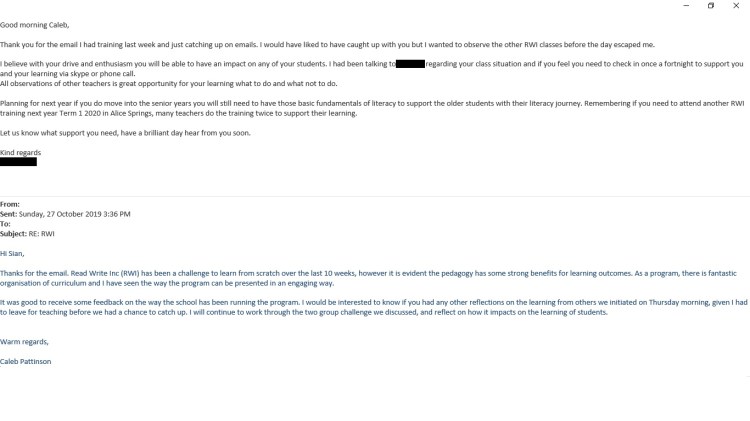
In order to maximise effectiveness of the RWI program as an educator – I aim to use support where available. This can be in the form of colloquial, professional conversations with peers, advocating for internal Professional Development in the program, or as above – having a discourse with the professional support available. The conversations that take place over the effectiveness of the program are always fascinating. It is important in the moments of passionate discourse in education to remember that educational outcomes should remain the priority.
Teaching in community comes with a range of challenges, however the access to an equitable education is a seemingly never ending battle. Through the Read Write Inc. program, students are grouped in assessment level groups. Bradbury states, “The idea that some children are naturally ‘bright’ is a common-sense, everyday trope in schools and wider society, but the concomitant notion that some children are ‘less able’ or ‘slow’ is more controversial.”2 Grouping by assessment is a challenging enigma in a mainstream school, even before considering the additional challenges that remote education has to navigate.
Read Write Inc. is a pedagogical approach that has the potential to engage a cohort of students who have English as a Second Language. It appears to be empowering learning progress in a remote school, however as educators we must always be cautious that we are not consistently trying to improve our practise.
1Read Write Inc. (2019). Retrieved 12 November 2019, from https://www.oup.com.au/primary/phonics/read-write-inc
2Bradbury, A. (2018). The impact of the Phonics Screening Check on grouping by ability: A ‘necessary evil’ amid the policy storm. British Educational Research Journal, 44(4), 539-556. doi: 10.1002/berj.3449
AITSL Standards: 1.2, 1.3, 1.4, 1.5, 2.1, 2.2, 2.3, 2.5, 3.1, 3.2, 3.3, 3.4, 3.6, 4.2, 5.1, 5.2, 5.4, 6.2, 6.3, 6.4
 The Remote Teacher